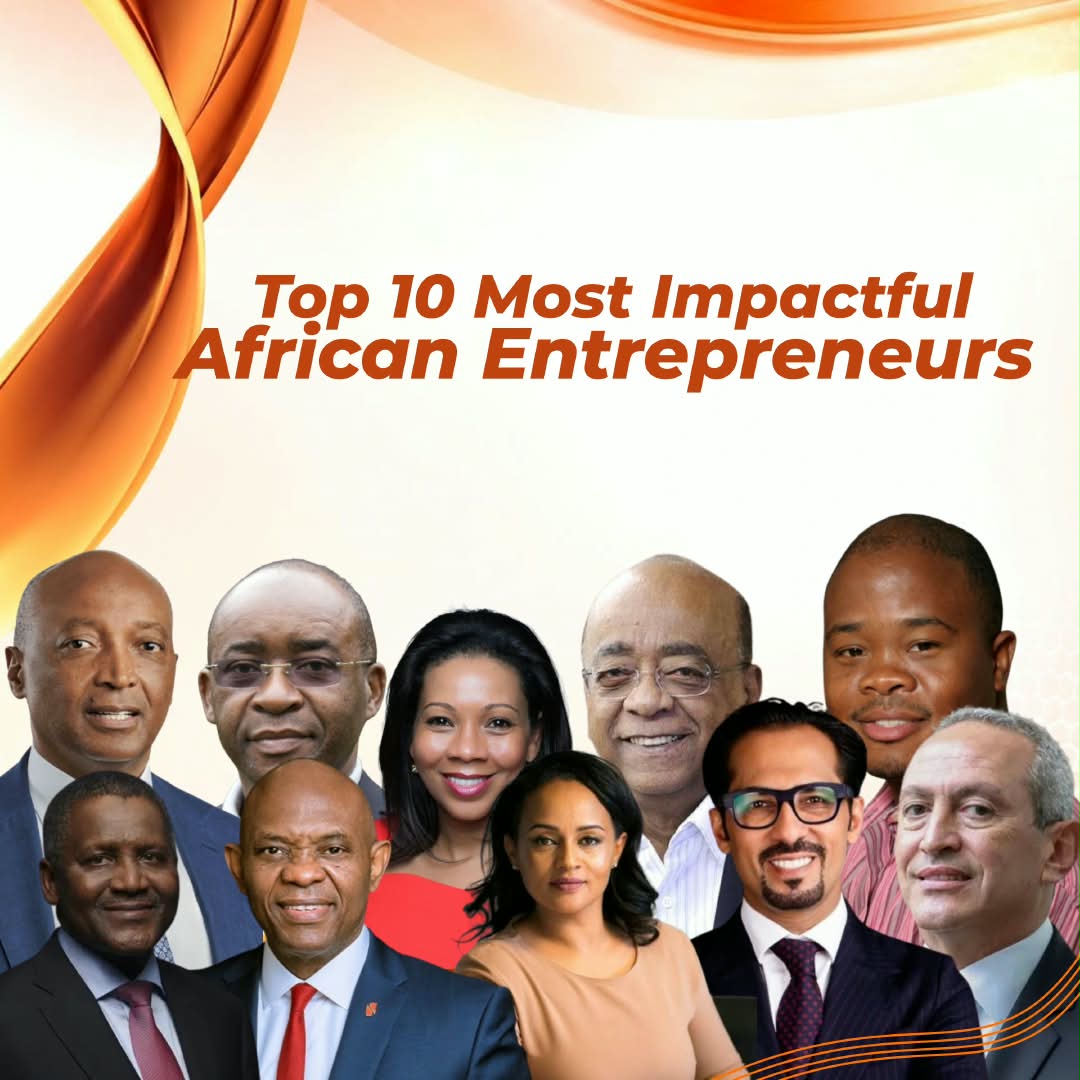

When African entrepreneurs are discussed, the conversation often centres on one question: Who is the richest?
But wealth alone does not tell the full story of entrepreneurial success.
An entrepreneur can build a massive company, but the true scale of their contribution can also be measured by the jobs they create, the industries they build, the opportunities they open for other entrepreneurs and the lives they improve through philanthropy and social investment.
That is the approach behind this ranking. The following entrepreneurs stand out for the different ways they have turned business success into wider opportunities for Africans.
1. Strive Masiyiwa — Zimbabwe
At number one is Strive Masiyiwa, the Zimbabwean entrepreneur whose influence stretches from telecommunications and technology to education and philanthropy.
Masiyiwa founded Econet and became one of the pioneers of Africa’s telecommunications revolution. His business interests have helped expand access to mobile and digital services across the continent, while creating employment and supporting wider technology ecosystems.
But his impact extends far beyond business.
Through Higherlife Foundation, which he founded with his wife, Tsitsi Masiyiwa, the family has invested in education, healthcare, livelihoods and other social programmes. The Foundation currently supports initiatives ranging from scholarships and healthcare to climate-smart agriculture and rural livelihoods. It continues to run the Joshua Nkomo Scholarship programme in 2026.
Masiyiwa’s significance is therefore not simply that he built a major African business, he has simultaneously invested in connectivity, human capital and opportunity. That combination gives him a strong claim to the number-one position on this list.
2. Tony Elumelu — Nigeria
If this ranking were based solely on developing other African entrepreneurs, Tony Elumelu could easily occupy the number-one position.
Through the Tony Elumelu Foundation (TEF), Elumelu has turned entrepreneurship support into a continental movement.
Since 2015, the Foundation says its programme has funded more than 24,000 entrepreneurs, trained 2.5 million Africans, created more than 1.5 million jobs and generated significant business activity.
Its reach is particularly significant because the programme is designed for entrepreneurs across Africa rather than concentrating on one country.
In 2026, TEF selected another 3,200 African entrepreneurs for its programme, continuing its model of providing entrepreneurs with training, mentorship and seed capital.
Elumelu’s influence therefore goes beyond the companies he has built. He has helped thousands of Africans become business owners themselves.
His philosophy of Africapitalism; the idea that African private-sector investment can drive economic and social development, has also become a major part of his public contribution to the continent.
3. Aliko Dangote — Nigeria
Few African entrepreneurs have had as direct an influence on industrialisation as Aliko Dangote.
Through the Dangote Group, he has built major businesses across cement, food, manufacturing and energy, creating employment while developing large-scale production capacity in Africa.
The Dangote Refinery alone represents one of the continent’s most ambitious industrial projects. The $20 billion facility has a stated capacity of around 700,000 barrels of crude oil per day and is increasingly supplying petroleum products to African and international markets.
That matters because Dangote’s business model is largely built around producing in Africa rather than simply importing into Africa.
His philanthropic contribution is also substantial. In the first six months of 2026, Dangote publicly donated or pledged at least $47 million to various causes, including food security, university education and hunger relief.
His Foundation has also continued investing in leadership development, including the 2026 Aliko Dangote Fellows programme in partnership with the World Economic Forum.
Dangote’s impact is therefore particularly strong in industrialisation, employment, local production and philanthropy.
4. Fred Swaniker — Ghana
Fred Swaniker’s impact is different from that of entrepreneurs who measure their influence primarily through factories, revenues or employee numbers. His central product is human capital.
The Ghanaian entrepreneur founded the African Leadership Academy, African Leadership University and later ALX as part of the wider African Leadership Group. The group describes its mission as developing three million ethical and entrepreneurial African leaders by 2035. That makes Swaniker particularly important in the context of Africa’s youth population and employment challenge.
Rather than simply creating jobs inside one company, his model focuses on producing people capable of creating businesses, leading organisations and solving African problems.
He has also expanded his entrepreneurial activities into technology through Sand Technologies, a global technology company focused on advanced technologies including AI.
Swaniker earns the fourth position because his impact is less about the number of people directly employed by his companies and more about the African entrepreneurs and leaders his institutions are producing.
5. Patrice Motsepe — South Africa
South African billionaire and mining entrepreneur Patrice Motsepe has combined business success with a substantial philanthropic footprint.
As founder of African Rainbow Minerals, Motsepe became one of the continent’s most prominent mining entrepreneurs.
But his impact extends beyond mining. The Motsepe Foundation works across education, community development, entrepreneurship, employment and social cohesion in South Africa.
The Foundation has also expanded its support for social entrepreneurs. In 2026, it announced a programme involving more than 140 social-impact entrepreneurs across several African countries over four years.
This combination of business, philanthropy and entrepreneurship development gives Motsepe a strong position on the list. His story demonstrates that an entrepreneur’s influence can extend from an industry into the wider communities surrounding it.
6. Mo Ibrahim — Sudan
Mo Ibrahim’s impact cannot be measured primarily through the number of factories he owns or employees on his payroll.
His contribution is largely centred on African leadership and governance.
After building his telecommunications career, Ibrahim established the Mo Ibrahim Foundation, which focuses on leadership, governance and development in Africa.
One of its best-known initiatives is the Ibrahim Leadership Fellowship, which gives promising African professionals opportunities to work within major African and international institutions.
The 2026 fellowship cohort included three African professionals undertaking one-year programmes at leading multilateral institutions.
The Foundation’s broader work also provides data and analysis on African governance, helping policymakers, researchers and citizens understand how African countries are performing.
Ibrahim therefore earns his place because of institutional impact—an area that is often overlooked when entrepreneurial success is discussed.
7. Nassef Sawiris — Egypt
Egyptian entrepreneur Nassef Sawiris represents the intersection of large-scale business and long-term social investment.
His business interests have extended across major industrial and construction-related sectors, while his family’s philanthropic activities have focused heavily on education, poverty reduction and economic opportunity.
The Sawiris Foundation for Social Development currently operates under a strategy focused on reducing multidimensional poverty and empowering people capable of driving positive change in Egypt.
Its 2026 activities include healthcare initiatives, employment opportunities and programmes supporting vulnerable communities. One 2026 partnership, for example, involves healthcare services reaching more than 21,000 children in Egypt.
Sawiris’ impact therefore combines economic scale with human-capital and social development.
8. Mohammed Dewji — Tanzania
Mohammed Dewji is one of Tanzania’s most prominent entrepreneurs and the leader of MeTL Group, a diversified business empire with interests spanning manufacturing, agriculture, trading and other sectors.
His entrepreneurial impact comes largely from building businesses that operate across important parts of Tanzania’s economy.
But his social impact is equally notable. Through the Mo Dewji Foundation, initiatives focus on education, healthcare and access to clean water, particularly for disadvantaged communities.
According to MeTL, the Foundation has impacted the lives of more than 100,000 people over the past seven years through these programmes.
Dewji therefore represents a model of entrepreneurship in which business expansion and community development operate alongside one another.
9. Bethlehem Tilahun Alemu — Ethiopia
Bethlehem Tilahun Alemu brings something particularly valuable to this list: a globally recognised African brand built around local skills and resources.
She founded soleRebels in Addis Ababa after observing that her community had skilled artisans but limited employment opportunities.
Instead of treating those skills as a social problem, she turned them into a business opportunity.
The company uses Ethiopian craftsmanship and locally sourced materials to produce footwear for international markets. The World Economic Forum has described soleRebels as an African footwear brand that created hundreds of well-paid jobs in Ethiopia while promoting African creativity globally.
The company’s own account says it began specifically to create jobs in the Zenabwork community and eventually expanded into an international brand.
Alemu’s significance is therefore bigger than footwear.
She demonstrated that African entrepreneurs can take local talent, local materials and local culture and turn them into globally marketable products. That is exactly the kind of entrepreneurship Africa needs more of.
10. Rebecca Enonchong — Cameroon
Closing the list is Cameroonian technology entrepreneur Rebecca Enonchong.
Enonchong founded AppsTech, an enterprise software company that serves clients internationally. More importantly for this ranking, her influence extends beyond her own company into Africa’s broader technology ecosystem.
She has been involved with organisations including AfriLabs, ActivSpaces and the African Business Angel Network, supporting entrepreneurs, innovation hubs and technology development across the continent.
AppsTech has grown into a global enterprise software business supporting clients in more than 50 countries, according to a 2025 profile of the company.
Her impact therefore comes from two directions: building an African technology company capable of competing internationally and helping strengthen the ecosystem in which other African technology entrepreneurs operate.
How We Ranked the 10 Entrepreneurs
It is important to emphasize that this is not a ranking of wealth.
IABC Entrepreneurs Development Company considered three broad dimensions:
|
Criteria |
What We Considered |
|
African entrepreneurship |
Businesses built, industries influenced, innovation and contribution to African enterprise. |
|
Job creation & economic contribution |
Direct/indirect employment, business ecosystems, production capacity and economic opportunities. |
|
Social impact |
Philanthropy, education, healthcare, leadership development, poverty reduction and community development. |
The ranking reflects the overall breadth and depth of impact, rather than one single number.
This is also why someone such as Fred Swaniker can rank ahead of a much wealthier entrepreneur: the impact of developing thousands or potentially millions of future African leaders and entrepreneurs is difficult to capture through personal wealth or company size alone.
What These Entrepreneurs Have in Common
Despite operating in different industries and countries, the entrepreneurs on this list demonstrate several important lessons.
They built businesses around real African needs. From telecommunications and manufacturing to education, technology, agriculture and consumer products, their ventures address problems and opportunities within African markets.
They created opportunities beyond themselves. The strongest entrepreneurs do not only create personal wealth. They create jobs, suppliers, distributors, entrepreneurs, employees and entire business ecosystems.
They invested in people. Education, training, mentorship, scholarships and leadership development appear repeatedly across their stories.
They used business as a platform for wider impact. Their philanthropic work shows that entrepreneurship can become a vehicle for addressing social problems alongside commercial objectives.
Conclusion
The most impactful African entrepreneurs are not necessarily the continent’s richest people. Their impact is better understood by asking a different set of questions:
How many people have they employed?
How many businesses have they helped create?
What industries have they built?
How many young people have gained access to education, training or opportunity because of their work?
And what difference have their businesses and philanthropy made to ordinary Africans?
By those measures, entrepreneurs such as Strive Masiyiwa, Tony Elumelu, Aliko Dangote, Fred Swaniker and Patrice Motsepe demonstrate different but powerful models of African impact.
Some have built industrial giants. Some have connected millions of people. Others have invested in entrepreneurs, education, leadership or communities.
Their stories ultimately point to a broader lesson: African entrepreneurship is most powerful when business success creates opportunities that extend far beyond the entrepreneur. And that may be the most meaningful measure of success, not simply how much wealth an entrepreneur creates, but how much value they create for Africa.
