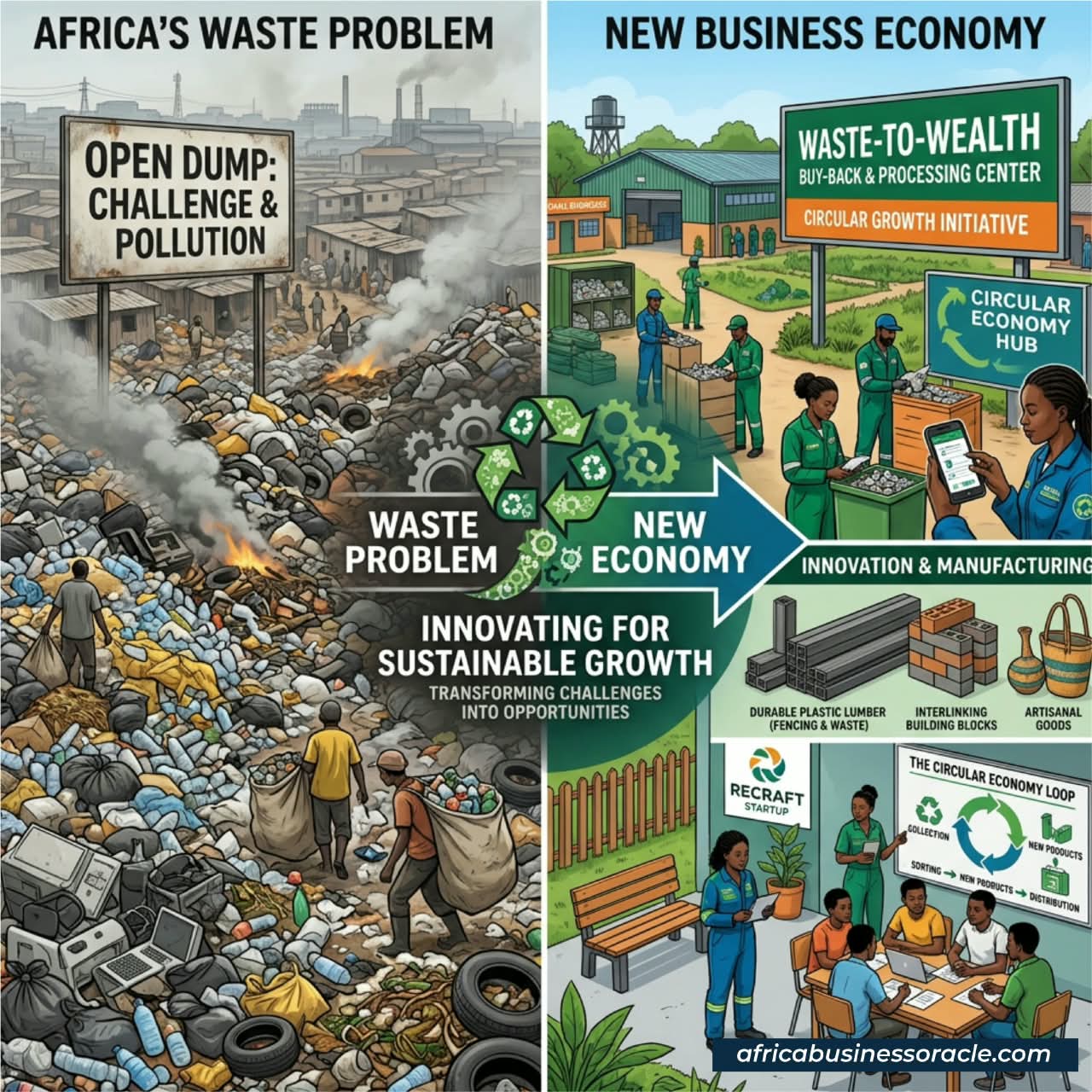

Every day, tonnes of plastic bottles, food scraps, discarded electronics, paper, metal and other materials are thrown away across African cities. Much of this waste ends up in open dumpsites, drainage channels and waterways, creating environmental and public health challenges.
But beneath this growing problem is an economic opportunity that is attracting entrepreneurs, investors and businesses looking beyond traditional industries.
Africa’s waste challenge is creating demand for businesses that can collect, sort, process, recycle and convert discarded materials into useful products. What was once considered rubbish is increasingly being recognised as a potential source of raw materials, energy, agricultural inputs and employment.
According to the United Nations Environment Programme (UNEP), approximately 70–80% of municipal solid waste generated in Africa is potentially recyclable, yet only about 4% is currently recycled. The organisation’s Africa Waste Management Outlook highlights the significant gap between the volume of recoverable materials and the continent’s existing recycling capacity. (UNEP – Africa Waste Management Outlook)
The economic potential is equally significant. In 2026, the African Development Bank reported that recovering municipal waste across the continent could generate approximately $8 billion annually. It also estimated that discarded electronic equipment contains up to $3 billion worth of recoverable raw materials. (AFDB – Greater Investment to Unlock Africa’s Circular Economy Potential)
These figures point to an emerging business economy in which waste management is no longer limited to collection and disposal. It is becoming part of a wider circular economy built around recovering resources, creating new products and reducing dependence on virgin materials.
Here are some of the business opportunities emerging from Africa’s waste problem.
1. Plastic Recycling and Recycled Product Manufacturing
Plastic waste is one of the most visible challenges facing African cities. Water sachets, plastic bottles, food packaging, shopping bags and other plastic products are discarded in large quantities, often without proper collection or processing.
However, these materials can become valuable inputs for manufacturing.
Businesses can collect and process discarded plastics into reusable raw materials, which can then be supplied to manufacturers producing packaging, household products, containers, furniture and construction materials.
There are also opportunities for companies that manufacture products directly from recycled plastics, including paving blocks, plastic lumber, storage containers and other durable items.
For entrepreneurs, the opportunity exists at different levels of the value chain. A business could specialise in collecting plastic waste, operating a sorting and washing facility, producing recycled plastic pellets or manufacturing finished products.
The important consideration is quality. Recycled materials must meet the specifications required by manufacturers and customers if businesses want to build sustainable markets.
2. Organic Waste, Compost and Agricultural Inputs
Not all waste is plastic or metal. A significant proportion of Africa’s waste consists of organic materials, including food leftovers, fruit peels, vegetable scraps, agricultural residues and other biodegradable matter.
The Africa Waste Management Outlook, published by UNEP and the Council for Scientific and Industrial Research, identifies organic materials as the largest component of municipal solid waste in much of sub-Saharan Africa, accounting for approximately 57% of the waste stream. (UNEP and CSIR – Africa Waste Management Outlook)
Rather than allowing these materials to decompose in uncontrolled dumpsites, businesses can process them into compost and other useful agricultural inputs.
Composting companies can collect organic waste from markets, restaurants, hotels, households and food-processing businesses before converting it into organic fertilizer for farmers, gardeners and landscaping companies.
There is also potential in producing soil conditioners and specialised growing media for horticulture and urban farming. This opportunity connects two important sectors: waste management and agriculture. Farmers need affordable ways to improve soil quality, while cities and food businesses need better systems for managing organic waste.
Businesses that can establish reliable collection arrangements and produce consistent, quality-controlled compost can serve both markets.
3. E-Waste Collection and Electronic Materials Recovery
As the use of smartphones, computers, televisions, household appliances and other electronic devices increases, so does the volume of electronic waste.
Discarded electronics are not ordinary rubbish. They can contain recoverable materials such as copper, aluminium, gold and other valuable components. However, improper handling can expose workers and communities to hazardous substances.
This creates opportunities for specialised e-waste businesses.
Entrepreneurs can establish collection centres where individuals, offices, schools and organisations can safely dispose of unwanted electronics. Others can focus on repairing and refurbishing used devices, recovering functional components or partnering with licensed recycling facilities to extract valuable materials.
There is also demand for corporate e-waste management services, particularly among businesses that regularly replace computers, printers, servers and other equipment.
The African Development Bank estimates that discarded electronic equipment across the continent contains up to $3 billion in recoverable raw materials, including valuable minerals that could be returned to productive use. (AFDB – Circular Economy Potential in Africa)
However, e-waste businesses require appropriate technical expertise, environmental safeguards and responsible handling procedures. The value of recovered materials should never come at the expense of workers’ health or environmental safety.
4. Waste Collection and Recycling Logistics
Before waste can be recycled or converted into useful products, it must first be collected. This creates opportunities for businesses that specialise in waste collection, transportation, sorting and aggregation.
In many African cities, waste collection remains inconsistent, particularly in densely populated communities and areas that are poorly served by formal waste management systems.
Private companies can address these gaps by providing scheduled household waste collection, commercial waste services and specialised collection for recyclable materials.
There is also room for businesses that operate collection hubs where waste pickers, households and small collectors can bring sorted materials for weighing and payment.
Technology can make these operations more efficient. Businesses can use digital platforms to schedule pickups, monitor collection routes, record material volumes and connect collectors with recycling companies.
The opportunity is not necessarily to build a large recycling factory. A well-organised collection and supply business can become an important link between waste generators and manufacturers that need recovered materials.
5. Upcycling and Sustainable Product Manufacturing
Recycling usually involves processing waste materials into raw materials that can be used again. Upcycling takes a different approach by transforming discarded items into new products with additional functional or commercial value.
This creates opportunities for creative entrepreneurs and small manufacturing businesses.
Discarded tyres can be transformed into furniture and outdoor products. Wooden pallets can become shelves, tables and decorative pieces. Used fabrics can be converted into bags, accessories and household items, while discarded glass can be redesigned into decorative products.
Businesses can also build brands around sustainable fashion, handmade products and environmentally responsible home accessories.
One advantage of this market is that entrepreneurs can often begin with relatively small production operations before expanding.
However, successful upcycling requires more than creativity. Products must have good finishing, durability, attractive designs and a clear target market. Customers need a reason to purchase them beyond the fact that they are made from recycled materials.
6. Waste-to-Energy and Biogas Production
Organic waste can also create opportunities in renewable energy.
When food waste, agricultural residues and other biodegradable materials are processed through anaerobic digestion, they produce biogas that can be used for heating, electricity generation and other energy applications.
Businesses can develop biogas facilities that process organic waste from farms, food-processing companies, markets, restaurants and other commercial establishments.
The process can also produce digestate, which may be used as a soil amendment when properly treated and tested.
This creates a business model that can generate value from both the waste received and the energy produced.
However, waste-to-energy projects require careful assessment. Not all waste is suitable for the same technology, and the moisture content and composition of waste can affect how efficiently it is processed.
For many African markets, decentralised biogas systems and organic waste recovery may offer practical opportunities, particularly where reliable supplies of agricultural and food waste are available.
7. Waste Management Technology and Digital Platforms
The waste economy also has room for technology-driven businesses.
Managing waste involves several activities, including collection, sorting, transportation, payments, inventory management and connecting suppliers with buyers. When these processes are poorly coordinated, recyclable materials can be lost and operating costs can increase.
Technology entrepreneurs can develop digital platforms that address these challenges.
Possible solutions include applications that connect households with waste collectors, platforms that allow recycling companies to purchase materials from verified suppliers, digital systems for tracking waste collection and software that helps businesses monitor their waste generation.
There are also opportunities in digital marketplaces where buyers and sellers can trade recyclable materials.
For example, a manufacturing company looking for a consistent supply of recycled plastic could use a platform to identify suppliers, compare material quality and coordinate deliveries.
The commercial value of these platforms will depend on their ability to solve practical problems, build trust and attract enough participants to sustain transactions.
8. Waste Management Services for Businesses and Institutions
Households are not the only producers of waste. Hotels, restaurants, shopping centres, hospitals, offices, factories, schools and event centres generate different types of waste that require organised management.
This creates opportunities for specialised business-to-business waste management services.
A company could provide waste audits, collection arrangements, sorting systems, recycling partnerships and disposal coordination for commercial clients.
Restaurants and hotels, for instance, can benefit from services that separate food waste from plastics and other recyclable materials. Offices can arrange scheduled collection of paper, packaging and electronic waste.
Manufacturing businesses may also require support in managing production waste and identifying materials that can be reused or sold.
These services can generate recurring revenue through contracts and long-term partnerships, making them attractive to entrepreneurs who prefer predictable business relationships rather than relying entirely on individual transactions.
9. Repair, Refurbishment and Resale Businesses
One of the simplest ways to reduce waste is to extend the useful life of products before they are discarded. This creates business opportunities in repairing, refurbishing and reselling items such as electronics, furniture, household appliances, clothing and machinery.
In many African markets, consumers are already familiar with purchasing second-hand products. However, businesses can create additional value by offering professionally inspected, repaired and refurbished items with transparent pricing and limited warranties.
Entrepreneurs can establish repair centres, refurbished electronics stores, used furniture businesses or online marketplaces for pre-owned products.
Manufacturers and retailers can also explore take-back programmes that allow customers to return old products for repair, refurbishment or responsible recycling.
This model creates value by recovering products that would otherwise become waste while making useful goods more accessible to customers.
10. Waste-Based Construction Materials
The construction industry presents another opportunity for businesses that can turn discarded materials into useful building products.
Certain waste materials, when properly processed and tested, can be incorporated into construction applications. Recycled plastics, glass, rubber and selected industrial by-products can be used in products such as paving materials, insulation components, tiles and other construction inputs.
For example, businesses can explore manufacturing paving blocks from recycled plastic or developing construction products that incorporate suitable recycled materials.
The opportunity is particularly relevant in markets where housing demand is increasing and developers are searching for ways to manage construction costs.
However, building materials must meet applicable engineering standards and safety requirements. Products should be tested for strength, durability, fire performance and suitability for their intended use.
The goal should be to create reliable construction products, not simply find somewhere to put discarded materials.
What Will It Take to Build a Successful Waste Business in Africa?
Although the opportunities are significant, turning waste into a profitable business requires more than identifying discarded materials.
One of the biggest challenges is securing a consistent supply of properly sorted waste. A recycling company cannot operate efficiently if it receives unpredictable quantities of contaminated materials.
Businesses must therefore develop reliable collection networks and establish relationships with households, markets, commercial establishments, waste pickers and local authorities.
Access to processing equipment and financing is another consideration. Some waste businesses can begin with basic collection and sorting operations, while others require specialised machinery, storage facilities and technical expertise.
There must also be a reliable market for the recovered materials. Before investing in expensive equipment, entrepreneurs should understand who will purchase their finished products, what quality standards buyers require and how much they are willing to pay.
Government policies and regulations will also influence the sector. Clear waste management rules, effective enforcement, supportive recycling policies and partnerships with private operators can help businesses operate more confidently.
Importantly, the informal waste sector must not be overlooked. Thousands of waste pickers and small-scale collectors already play a role in recovering valuable materials across African cities. UNEP’s Africa Waste Management Outlook identifies the integration of informal waste workers into more organised systems as an important part of improving waste management across the continent. (UNEP – Africa Waste Management Outlook)
The scale of investment required is also attracting attention. In April 2026, the World Bank approved $250 million in financing for Kinshasa’s Urban Transformation and Jobs Programme in the Democratic Republic of Congo. The programme includes investments in waste collection infrastructure, waste management facilities, private-sector partnerships and employment opportunities for women and young people. (World Bank – $250 Million to Transform Kinshasa’s Waste Management and Create Jobs)
The programme demonstrates how waste management can become part of a broader economic development strategy, creating opportunities for businesses involved in collection, transportation, recycling and related services.
Conclusion
Africa’s waste problem is creating a new business economy, and its opportunities extend far beyond recycling plastic bottles.
From organic fertilizer and electronic materials recovery to refurbished products, waste collection technology, biogas and sustainable construction materials, entrepreneurs have opportunities to build businesses around materials that are currently being discarded.
The transition will require investment, technical expertise, reliable supply chains and stronger collaboration between governments and private businesses. But the economic case is becoming increasingly difficult to ignore.
For African entrepreneurs and investors, the question is no longer just how to manage the waste being generated. It is how to recover its value, turn it into useful products and build commercially sustainable businesses around the process.
The next generation of waste businesses may not be built around what people throw away, but around what those discarded materials can become.
