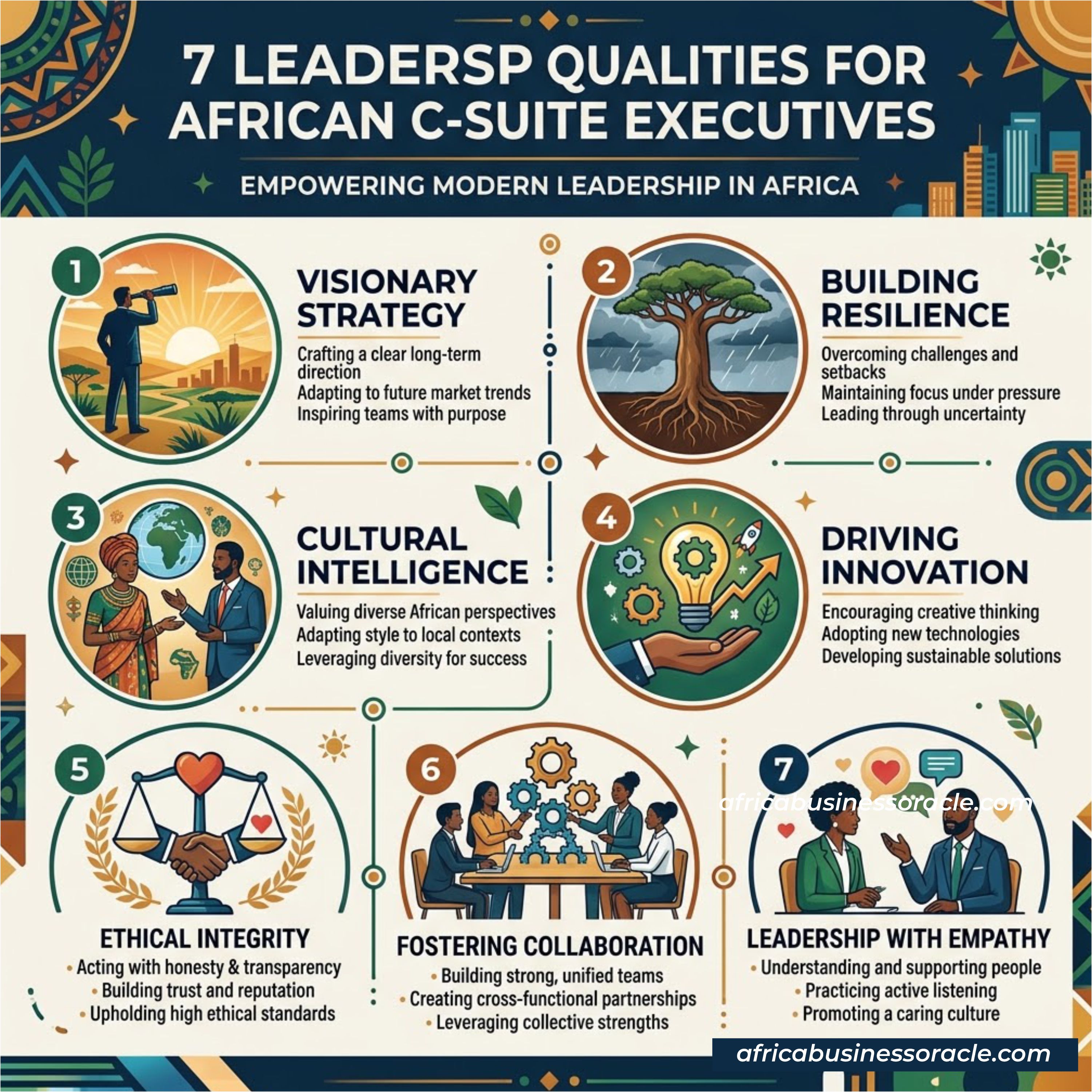

Being a C-suite executive is about more than having an impressive title, occupying the corner office or making the final decision in a boardroom. It is about taking responsibility for an organisation’s direction, its people, its performance and its future.
For African executives, that responsibility comes with a unique set of challenges. Businesses must navigate changing economic conditions, currency pressures, infrastructure gaps, evolving regulations, technological disruption and increasingly competitive markets. At the same time, they must identify opportunities for growth, retain talented employees and build organisations that can compete beyond their immediate markets.
The expectations of executive leadership are also changing. According to KPMG’s 2025 Africa CEO Outlook, African CEOs increasingly recognise the importance of digital literacy, agility, faster decision-making and an understanding of artificial intelligence. Meanwhile, PwC’s 2026 Africa perspective highlights the importance of innovation and long-term business reinvention.
These findings point to an important reality: experience and technical expertise remain valuable, but they are no longer enough on their own.
So, what qualities should African C-suite executives cultivate to lead effectively, build stronger organisations and remain relevant in a rapidly changing business environment?
Here are seven worth developing.
1. Strategic Thinking and Long-Term Vision
A good executive understands what is happening in the business today. A great executive also anticipates what the business may need tomorrow.
Strategic thinking involves looking beyond daily operations to understand market changes, customer behaviour, emerging competitors, industry trends and the long-term implications of business decisions.
For African executives, this quality is particularly important because operating conditions can change quickly. Currency fluctuations, policy adjustments, changing consumer purchasing power and supply-chain disruptions can affect business plans with little warning.
However, strategic leadership is not simply about reacting to the latest challenge. It is about building an organisation that can withstand uncertainty while pursuing clear long-term objectives.
Consider a manufacturing company facing rising production costs. An executive focused only on the immediate problem might increase prices or reduce expenditure. A strategic executive would also examine local sourcing opportunities, production efficiency, alternative suppliers, product innovation and potential export markets.
The difference is that the second approach addresses the immediate pressure while considering the organisation’s future competitiveness.
How to develop this quality:
* Set clear short-term and long-term business objectives.
* Study industry trends and changes in customer behaviour.
* Evaluate how economic and regulatory developments could affect your organisation.
* Consider the long-term consequences of major decisions rather than focusing exclusively on immediate results.
* Regularly review your strategy and adjust it when evidence shows that change is necessary.
A C-suite executive must be able to answer a fundamental question: Where are we taking this organisation, and why is that direction the right one?
2. Adaptability and Decisiveness Under Pressure
Leadership becomes particularly visible when circumstances do not go according to plan.
Markets change. Projects fail. Customers alter their expectations. Employees leave. New technologies disrupt established business models. Sometimes, executives must make difficult decisions without having all the information they would ideally want.
This is where adaptability becomes essential.
Adaptability does not mean abandoning a strategy whenever a new challenge appears. It means recognising when existing approaches are no longer effective and having the courage to adjust.
For African executives, this quality can be especially valuable in environments where businesses must regularly respond to economic uncertainty, infrastructure constraints, shifting customer demand and changing regulations.
According to KPMG’s 2025 Africa CEO Outlook, African CEOs identified agility and faster decision-making under pressure among the leadership capabilities becoming increasingly important.
Imagine a retailer whose customers are becoming more price-conscious. Rather than continuing with the same pricing and inventory strategy, an adaptable executive might introduce more affordable product options, negotiate better supplier terms, improve inventory management or expand digital sales channels.
The objective is not to make change for its own sake. It is to respond intelligently to changing circumstances.
Decisiveness matters just as much. Constantly postponing difficult decisions can cost an organisation valuable time, money and opportunities.
How to develop this quality:
* Make decisions using the best available evidence and clearly understood risks.
* Establish contingency plans for major business threats.
* Review unsuccessful decisions to identify lessons without automatically blaming individuals.
* Remain open to new information, even when it challenges your assumptions.
* Know when further analysis is useful and when it has become an excuse for inaction.
The strongest executives are not necessarily those who always predict the future correctly. They are those who recognise change early, respond thoughtfully and help their organisations move forward.
3. Emotional Intelligence and People Management
An organisation’s performance depends significantly on the people responsible for delivering its goals.
Yet technical expertise and business knowledge do not automatically make someone an effective leader of people.
Emotional intelligence involves understanding your own emotions, recognising how your behaviour affects others, listening carefully and responding constructively to different personalities and situations.
For a C-suite executive, these abilities influence recruitment, employee engagement, conflict resolution, performance management and relationships with colleagues, customers and business partners.
Consider a talented employee whose performance has declined. An ineffective leader might immediately conclude that the employee has become lazy or uncommitted. An emotionally intelligent executive would investigate the situation, communicate expectations clearly and determine whether the problem involves workload, unclear responsibilities, inadequate support or an issue requiring formal performance management.
This does not mean avoiding difficult conversations or lowering standards. It means addressing problems with fairness, self-control and sound judgement.
Emotional intelligence is also important when leading teams across different African countries, cultures and professional backgrounds. Executives must understand that the same communication style may not work equally well with every employee or stakeholder.
How to develop this quality:
* Listen to employees before reaching conclusions.
* Learn to receive constructive criticism without becoming defensive.
* Communicate expectations clearly and respectfully.
* Address conflict early instead of allowing resentment to grow.
* Recognise employees’ contributions and give specific, useful feedback.
* Maintain professional boundaries while treating people with empathy.
Employees do not need an executive who agrees with everyone. They need a leader who can make difficult decisions without making people feel that their dignity does not matter.
4. Integrity, Accountability and Ethical Leadership
Trust is one of the most valuable assets an executive can build. It is also one of the easiest to lose.
C-suite executives influence major decisions involving company finances, recruitment, supplier relationships, customer data, regulatory compliance and organisational strategy. Their conduct can shape the behaviour of the entire organisation.
Integrity means doing what is right even when the decision is inconvenient, unpopular or financially tempting. Accountability means accepting responsibility for decisions and outcomes rather than consistently shifting blame to employees, market conditions or other departments.
These qualities are particularly important for businesses operating in environments where regulatory complexity, governance weaknesses or pressure to deliver quick results can create ethical challenges.
Imagine an executive who discovers that a major project has exceeded its budget because of poor planning. The temptation might be to conceal the problem, blame a subordinate or present misleading figures to the board.
An accountable executive would explain what happened, identify the causes, communicate the financial implications and establish measures to prevent a recurrence.
That approach may involve an uncomfortable conversation in the short term, but it helps protect the organisation’s credibility.
Ethical leadership also extends to how a company treats employees, customers, suppliers and the communities in which it operates.
How to develop this quality:
* Be transparent about business performance and significant risks.
* Establish clear standards for ethical conduct.
* Apply company policies consistently, regardless of an employee’s seniority.
* Disclose conflicts of interest and handle them appropriately.
* Take responsibility when decisions produce poor outcomes.
* Build systems that make accountability part of the organisation’s culture.
An executive’s reputation is built through repeated actions, not occasional speeches about integrity. When leaders demonstrate accountability, they make it easier for others to do the same.
5. Digital Literacy and a Willingness to Embrace Innovation
Technology is no longer exclusively the responsibility of the IT department. It has become a business leadership issue.
Artificial intelligence, data analytics, automation, cybersecurity and digital platforms are changing how organisations serve customers, manage employees, control costs and compete.
African C-suite executives must therefore understand how technology can create value for their organisations, even if they are not technical specialists.
The need is becoming increasingly clear. PwC’s 2026 Africa CEO survey findings identified slower AI deployment across business functions as an area where African businesses need to make progress.
Digital leadership does not mean adopting every new technology that attracts attention. It means understanding which tools solve genuine business problems and ensuring that investments produce measurable results.
For example, a financial services company might use data analytics to identify unusual transactions, while a retailer could use inventory software to reduce stock losses. A manufacturing company might introduce automation to improve quality control, while a professional services firm could use AI tools to assist with research and routine administrative work.
However, executives must also consider cybersecurity, customer privacy, data quality, employee training and the potential risks of relying on automated systems.
Technology investments can fail when organisations purchase tools without preparing employees to use them or defining what success should look like.
How to develop this quality:
* Understand the major technologies affecting your industry.
* Identify repetitive or inefficient processes that could benefit from digital tools.
* Learn to interpret business data before making significant decisions.
* Support employee training and responsible experimentation.
* Establish appropriate safeguards for customer information and company systems.
* Evaluate technology investments against measurable business outcomes.
The goal is not to become the most technologically sophisticated executive in the room. It is to become a leader who understands how technology can strengthen business performance and where human judgement remains essential.
6. Financial Acumen and Commercial Awareness
An executive can have excellent people skills, an inspiring vision and impressive communication abilities, but the organisation will struggle if its financial decisions are consistently poor.
Financial acumen involves understanding how business decisions affect revenue, costs, cash flow, profitability, investment and long-term sustainability.
It is especially important in African markets, where currency volatility, financing costs, energy expenses, import dependence and changing consumer purchasing power can significantly affect business performance.
A C-suite executive does not necessarily need to be an accountant or finance professional. However, every executive should understand the financial implications of decisions within their area of responsibility.
For instance, increasing sales does not automatically mean a company is becoming more profitable. If the cost of acquiring customers, producing goods or delivering services rises faster than revenue, growth can place additional pressure on the business.
Similarly, a company may report profits but still experience a cash-flow crisis if customers pay late while salaries, suppliers and other expenses must be settled immediately.
Financially aware executives understand these distinctions.
They ask whether a project will generate sufficient returns, whether the organisation can afford a proposed expansion, whether costs are being controlled and whether the business has enough liquidity to withstand unexpected difficulties.
How to develop this quality:
* Learn to interpret income statements, balance sheets and cash-flow statements.
* Understand the financial performance indicators most relevant to your organisation.
* Evaluate major projects using realistic cost and revenue assumptions.
* Monitor budgets and investigate significant variances.
* Understand the relationship between growth, profitability and cash flow.
* Work closely with finance teams while taking responsibility for the financial consequences of your own decisions.
Financial discipline does not mean refusing every investment that carries risk. It means understanding the risk, assessing the potential return and allocating resources responsibly.
7. Communication, Influence and Relationship Building
At the executive level, having a good strategy is not enough. You must be able to communicate it in a way that helps people understand, support and execute it.
C-suite executives communicate with boards, employees, investors, regulators, customers, business partners and the wider public. Each audience has different concerns, and effective communication requires understanding what matters to the people receiving the message.
A CEO explaining a restructuring to employees, for example, must communicate differently from a CFO presenting financial performance to investors. Both conversations require clarity, but the information, emphasis and level of detail will differ.
Strong communication also involves listening. Executives who dominate every conversation can miss important information from employees who understand operational problems more closely.
Influence is equally important. A senior title may give someone authority, but it does not automatically earn the confidence of employees or business partners.
Executives build influence by demonstrating competence, communicating consistently, following through on commitments and treating stakeholders fairly.
For African executives seeking international expansion, relationship building can also open doors to strategic partnerships, investment, distribution networks and new markets. Understanding cultural differences and building credibility across professional environments can make a meaningful difference.
How to develop this quality:
* Explain business priorities in clear, practical language.
* Adapt your communication to different audiences.
* Listen carefully to concerns before responding.
* Present ideas using evidence, relevant examples and clear reasoning.
* Build professional relationships before you urgently need assistance.
* Keep stakeholders informed when decisions or circumstances change.
* Ensure that your actions are consistent with what you communicate.
Ultimately, communication is not simply about delivering a convincing presentation. It is about creating enough clarity and trust for people to work towards a common objective.
How African C-Suite Executives Can Put These Qualities Into Practice
Developing these qualities requires more than reading leadership books or attending occasional executive seminars. It requires deliberate practice.
Executives can begin by conducting an honest assessment of their current strengths and weaknesses.
Are they good at setting direction but struggle to communicate it? Do they make decisions quickly but fail to consider their financial implications? Are they commercially strong but find it difficult to manage conflict? Do they understand their industry but lack confidence in evaluating digital investments?
Identifying these gaps makes professional development more practical.
It also helps to seek feedback from colleagues, board members, employees and trusted mentors. Seniority can sometimes insulate executives from honest criticism, making it harder to recognise habits that affect organisational performance.
Finally, leadership development should be tied to measurable improvements. An executive working on communication might focus on improving employee understanding of strategic priorities. Someone developing financial acumen could strengthen budget management and cash-flow forecasting. A leader embracing digital transformation could establish a pilot project with clear performance targets.
The objective is to turn leadership qualities into observable business results.
Conclusion: Leadership Must Deliver More Than Authority
Africa needs executives who can build competitive businesses, create employment, develop talent and navigate uncertainty without losing sight of ethics and long-term value.
Strategic thinking helps leaders determine where their organisations should go. Adaptability enables them to respond when circumstances change. Emotional intelligence strengthens their relationships with people, while integrity builds trust and accountability.
Digital literacy prepares businesses for technological change. Financial acumen supports responsible growth, and communication helps executives turn strategy into coordinated action.
No executive will demonstrate all seven qualities perfectly at every moment. What matters is the willingness to keep learning, accept feedback and improve.
For African C-suite executives, leadership is not simply about reaching the top of an organisation. It is about what they do with the responsibility once they get there.
The real measure of executive leadership is not the authority attached to the position, but the strength of the organisation, the people and the value created under that leadership.
