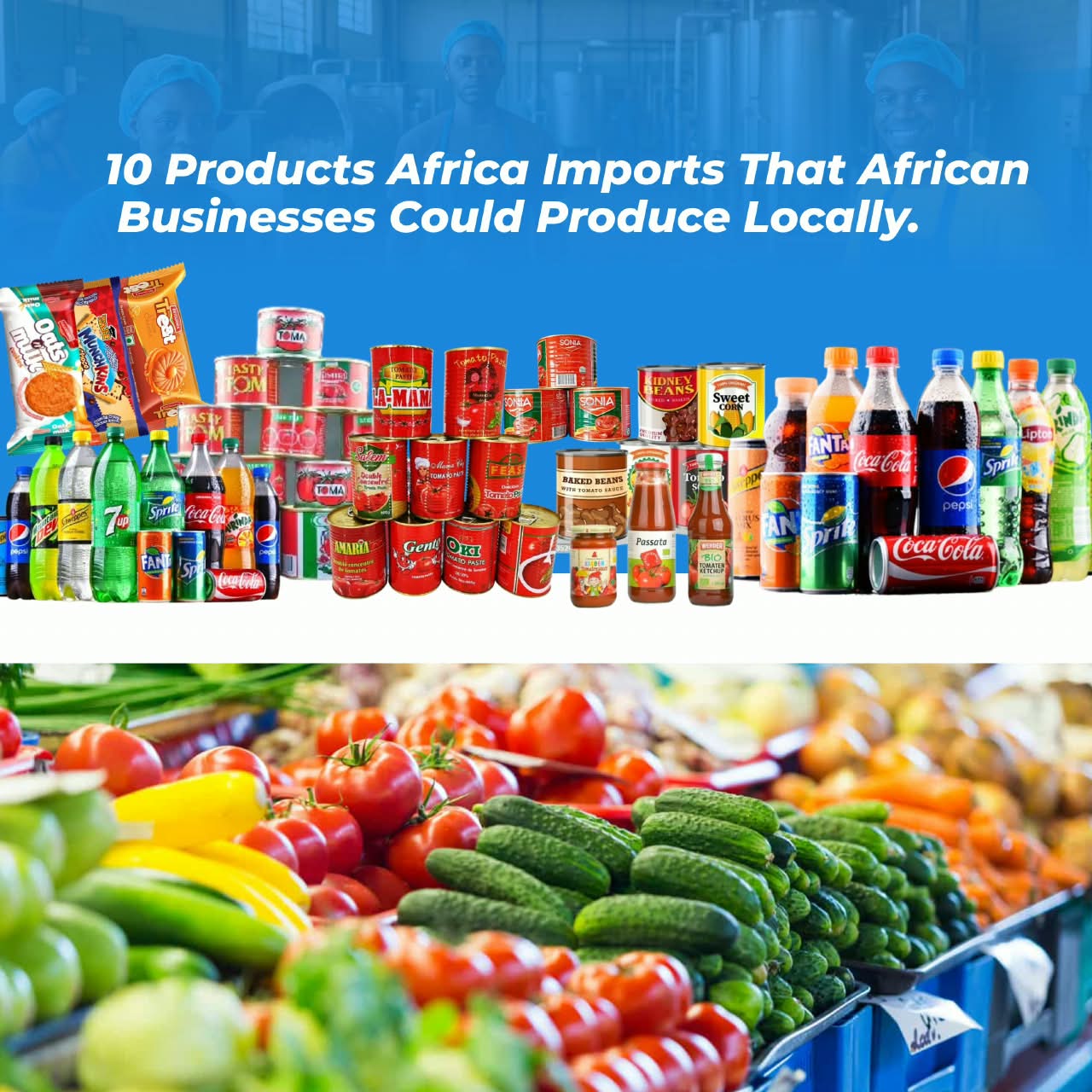

Africa has the raw materials, consumers and entrepreneurial talent to produce many of the goods it currently imports. Here are 10 major product categories that could create opportunities for African manufacturers while reducing import dependence and strengthening intra-African trade.
Africa’s business story is often told through the commodities it exports—oil, cocoa, gold, coffee, copper and other raw materials. But there is another side to the story: the manufactured products Africa continues to import in enormous quantities.
According to UN Trade and Development (UNCTAD), manufactured goods accounted for a significant share of Africa’s imports in 2025, with the continent importing nearly four times more manufactured goods than it exported. At the same time, 76.7% of Africa’s merchandise exports were primary goods.
That imbalance presents a challenge, but it also presents an enormous business opportunity.
Instead of exporting raw materials and importing finished products, African businesses can increasingly focus on processing, manufacturing and adding value locally. The African Continental Free Trade Area (AfCFTA) could make this opportunity even bigger by creating a larger market for products manufactured on the continent.
So, what products could African businesses produce locally?
1. Pharmaceuticals and Medical Supplies
Medicines are one of the clearest areas where Africa could benefit from increased local manufacturing.
Many African countries continue to depend heavily on imported medicines, medical consumables and pharmaceutical inputs. In Nigeria, for example, the Nigerian Investment Promotion Commission estimates that about 70% of pharmaceutical consumption is imported.
This creates opportunities for businesses involved in the production of:
* Generic medicines
* Over-the-counter drugs
* Basic medical consumables
* Laboratory supplies
* Protective medical equipment
* Pharmaceutical packaging
* Active pharmaceutical ingredients
The opportunity is not simply about replacing imports. A stronger pharmaceutical manufacturing industry could also position African countries to supply neighbouring markets.
Governments are beginning to recognize this opportunity. Nigeria, for instance, introduced measures in 2025 to reduce the cost of importing critical raw materials for pharmaceutical manufacturing and encourage local healthcare production.
2. Packaged Foods and Food Ingredients
Africa produces enormous quantities of agricultural commodities, yet significant amounts of processed food and food ingredients are imported.
This creates opportunities for businesses to move further up the agricultural value chain.
Instead of exporting crops as raw materials, entrepreneurs can produce:
* Tomato paste
* Fruit juices
* Breakfast cereals
* Flours
* Spices and seasonings
* Biscuits and snacks
* Canned foods
* Vegetable oils
* Dehydrated foods
* Ready-to-cook meals
Nigeria’s investment authorities specifically identify packaged food and beverages as an area where local manufacturing could displace imports while creating products suitable for regional export.
The opportunity extends across the continent because Africa has a large and growing consumer market.
3. Textiles and Garments
Africa has a long history of textile production, enormous demand for clothing and some of the raw materials required by the industry.
Yet many African consumers and businesses still rely heavily on imported fabrics, clothing and textile inputs.
This creates opportunities across the value chain, from spinning and weaving to dyeing, garment production and fashion manufacturing.
Businesses could produce:
* Fabrics
* School uniforms
* Workwear
* Ready-to-wear clothing
* Sportswear
* Traditional African clothing
* Bags and accessories
* Hotel and hospitality textiles
The biggest opportunity may not be trying to compete immediately with the cheapest mass-produced clothing from Asia. African manufacturers can instead focus on quality, cultural identity, speed-to-market and regional demand.
4. Fertilizers and Agricultural Inputs
Africa’s agricultural potential is enormous, but farmers need reliable access to fertilizers, crop protection products, improved seeds and other inputs.
Fertilizer is particularly important because agriculture cannot reach its full productivity without adequate soil nutrients.
There is already evidence of increasing local capacity. Nigeria’s Dangote Fertiliser, for example, has an annual production capacity of 3 million tonnes, according to the Nigerian Investment Promotion Commission.
Beyond large-scale fertilizer plants, opportunities exist for businesses involved in:
* Organic fertilizers
* Soil conditioners
* Compost products
* Agricultural chemicals
* Irrigation equipment
* Farm tools
* Greenhouse equipment
* Animal feed
The opportunity is especially significant when local agricultural production is connected to local processing.
5. Plastics and Packaging Materials
Plastic products and packaging are everywhere in African commerce, from food and beverages to pharmaceuticals, cosmetics, retail and manufacturing.
Yet many businesses still depend on imported packaging materials and plastic products.
There is room for African manufacturers to produce:
* Bottles
* Containers
* Food packaging
* Pharmaceutical packaging
* Plastic household products
* Industrial packaging
* Reusable packaging
* Biodegradable alternatives
Nigeria’s manufacturing sector is already benefiting from greater availability of domestic petrochemical feedstock, including polypropylene and polyethylene, creating opportunities for downstream plastics production.
For entrepreneurs, packaging is particularly interesting because practically every growing consumer business needs it.
6. Building Materials
Africa’s rapid urbanization means construction will continue to create demand for building materials.
Cement is already one of the continent’s major industrial success stories, but there are many other products that can be manufactured locally.
These include:
* Ceramic tiles
* Roofing materials
* Glass
* Sanitaryware
* Plasterboard
* Doors and windows
* Paints
* Insulation materials
* Stone products
* Decorative building materials
Nigeria’s investment promotion agency identifies several of these products as import-substitution opportunities despite the country’s existing strength in cement production.
This is an important lesson: local manufacturing does not always mean starting an entirely new industry. Sometimes the opportunity lies in producing the products surrounding an already established industry.
7. Furniture and Household Products
Africa’s growing population, expanding cities and rising demand for housing are creating a huge market for furniture and household products.
Yet many African markets continue to import finished furniture, lighting products and household items.
Local businesses could manufacture:
* Office furniture
* Home furniture
* Mattresses
* Kitchen cabinets
* School furniture
* Hotel furniture
* Lighting products
* Household storage products
* Home décor
The advantage for local manufacturers is that furniture can be designed around local tastes, housing sizes and consumer preferences while reducing the cost and logistical challenges associated with importing bulky finished products.
8. Electrical and Electronic Products
Africa’s digital transformation requires more than smartphones and internet connections. Businesses and households also need electrical and electronic equipment.
Nigeria’s 2025 import data, for example, shows electrical machinery and equipment among the country’s largest import categories.
Africa may not immediately begin producing sophisticated semiconductor chips at scale, but there are many simpler products that can be assembled or manufactured locally.
Potential areas include:
* Electrical cables
* Switches and sockets
* LED lighting
* Solar components
* Inverters
* Batteries
* Electrical control equipment
* Basic household appliances
* Electronic accessories
Local assembly can also serve as a stepping stone toward deeper manufacturing as skills, infrastructure and supply chains develop.
9. Machinery and Industrial Equipment
This may be one of the most difficult categories on the list, but also one of the most strategically important.
African businesses across agriculture, construction, manufacturing and mining need machinery and equipment, much of which is imported.
Nigeria’s 2025 import data placed machinery and mechanical appliances among its largest import categories.
African manufacturers could gradually develop capacity to produce or assemble:
* Agricultural machinery
* Processing equipment
* Construction equipment
* Industrial pumps
* Generators and power equipment
* Packaging machines
* Farm implements
* Replacement parts
The opportunity does not necessarily require an African company to manufacture an entire complex machine from scratch. Local assembly, components, maintenance and spare-parts manufacturing can be important starting points.
10. Cosmetics and Personal Care Products
Africa’s beauty and personal-care market presents another major opportunity for local manufacturing.
The continent has abundant ingredients that can be used in cosmetics and personal-care products, including shea butter, cocoa butter, palm oil and various botanical ingredients.
Businesses can develop:
* Soaps
* Body creams
* Hair products
* Skincare products
* Natural cosmetics
* Perfumes
* Essential oils
* Personal hygiene products
The opportunity is particularly attractive because African brands can combine local ingredients with modern branding and formulation to create products for African consumers and international markets.
Nigeria’s recent trade data, for example, shows imports of cosmetic and beauty preparations from other African markets, demonstrating that there is already regional demand for these products.
Why Local Production Matters for Africa
The case for producing more goods locally goes beyond reducing imports.
When businesses manufacture locally, they can create jobs, develop technical skills, build supply chains and create opportunities for smaller businesses that provide raw materials, transportation, packaging, maintenance and other services.
It can also help Africa capture more value from the resources it already possesses.
Consider cocoa. Exporting cocoa beans creates value, but processing those beans into cocoa powder, chocolate, beverages and other finished products creates additional stages of economic activity.
The same principle applies to cotton, oilseeds, palm products, agricultural produce, minerals and other resources.
Africa’s challenge is therefore not simply “How do we produce what we currently import?”
It is also “How do we turn what Africa already produces into products the world wants to buy?”
The AfCFTA Could Make Local Manufacturing More Powerful
One of the biggest advantages of producing locally is the possibility of selling beyond the domestic market. A manufacturer in Nigeria, Ghana, Kenya, Egypt, Rwanda or South Africa does not necessarily have to build a business around its home market alone.
The AfCFTA provides a framework for deeper continental trade, with data tools tracking product imports, tariff offers and rules of origin across member states.
That means a successful local manufacturer could eventually build a Made-in-Africa brand rather than simply a Made-in-Nigeria, Made-in-Ghana or Made-in-Kenya brand.
What African Businesses Need to Make This Happen
Local manufacturing will not succeed simply because imports are expensive or because governments encourage “buy local.”
Businesses need access to:
* Reliable electricity and infrastructure
* Affordable financing
* Skilled workers
* Modern machinery
* Quality raw materials
* Efficient transportation
* Consistent government policies
* Strong quality-control systems
* Regional and international markets
Most importantly, African manufacturers need to compete on quality and value, not merely on the fact that their products are locally made.
Consumers will support local products when those products are reliable, affordable, attractive and able to compete with imported alternatives.
Conclusion
Africa’s import bill is often discussed as a problem, but it can also be viewed as a map of business opportunities.
Pharmaceuticals, processed foods, textiles, agricultural inputs, plastics, building materials, furniture, electrical products, machinery and cosmetics are just some of the categories where greater local production could create value.
The opportunity is not to shut Africa off from international trade. Africa will continue to import products, machinery and technologies that are more efficiently produced elsewhere.
The bigger goal is to produce more of what Africa can competitively make, add value to its raw materials, and trade those products across the continent and with the rest of the world.
With the right investment, infrastructure, skills and policies, today’s imports could become tomorrow’s African industries, and today’s raw materials could become tomorrow’s globally competitive African brands.
